Abstraction means to focus on essential features of an element or object in OOP, ignoring its extraneous or accidental properties.
The essential features are relative to the context in which the object is being used.
Grady Booch has defined Abstraction as follows:
"An Abstraction denotes the essential characteristics of an object that distinguish it from other kind of objects and thus, Provides crisply defined conceptual boundaries, relative to prospective to viewer".
for example:
when a class student is designed the attributes student-id, Name, Course and Address are included while characteristics like pulse-rate and size of a shoe are eliminated , Since they are irrelevant in the Prospective of educational institution.
Saturday, December 31, 2016

Friday, December 30, 2016
Class (Basic concept of OOAD)
A class represents a collection of objects having same characteristics properties that exhibit common behavior. It gives the blue print or description of an object that can be created from it. creation of an object is an instance of a class.
The constitution of a class are:
- A set of attributes for the object that are to be instantiated from the class. Generally different objects of a class have some difference in values of the attributes . attributes are often refereed as a class data.
- A set of operations that shows the behavior of the objects of the class. operations are also refereed as functions or methods.
Let us consider a simple class, circle that represents the geometrical figure circle in 2 dimensional space.
some of its operations can be defined as findArea(): method to calculate area.
scale(): method to increase or decrease the radius.
During Instant-ion, values are assigned for at least some of the attributes.
if we create an object my_circle, we can assign values like x=2,y=3 and r=4, to depict its state .
now if the operation scale() is performed on my_cycle with a scaling factor 2 , the value of r will become 8.
This operation brings a change in the state of my_cycle. ie,the object has exhibited certain behavior.
Objects (Basic Concepts of OOAD)
An object is a real word element in an object oriented environment that may have a physical or a conceptual existence.
Objects can be modeled according to the needs of the application. An Object may have physical existence like a customer, a car etc. or an intangible conceptual existence like a project, a process etc.
Each Object has:
Objects can be modeled according to the needs of the application. An Object may have physical existence like a customer, a car etc. or an intangible conceptual existence like a project, a process etc.
Each Object has:
- Identity that distinguish it from other objects in the system.
- state that determines the characteristic properties that the object holds.
OOP(Introduction to OOAD)
It refers to a type of Computer Programming in which Programmers define not only the data type of data structure, but also the type of Operations (functions)that can be applied to data structure.
In this way the data structure becomes object that includes both data and functions. In addition, Programmers can create relationship between One Object and another Object.
Object Oriented Programming is a programming Paradigm based upon object (having both data and methods) that advantages of module and re usability.
Objects,which are usually instances of classes, are used to interact with one another to design application and computer programs.
Grady booch
Grady booch has defined Object Oriented Programing as "A method of Implementing in which Programs are Organized as co-operative collection of objects, each of which represents an instance of some Hierarchy of classes united via Inheritance relationship."
In this way the data structure becomes object that includes both data and functions. In addition, Programmers can create relationship between One Object and another Object.
Object Oriented Programming is a programming Paradigm based upon object (having both data and methods) that advantages of module and re usability.
Objects,which are usually instances of classes, are used to interact with one another to design application and computer programs.
Grady booch
Grady booch has defined Object Oriented Programing as "A method of Implementing in which Programs are Organized as co-operative collection of objects, each of which represents an instance of some Hierarchy of classes united via Inheritance relationship."
OOD (Introduction to OOAD)
Design emphasizes a conceptual solution that fulfill the requirement rather than its implementation.
for example: a description of database schema and software object.
Ultimately design can be implemented, Design encompasses the discipline approach. we use to invert a solution for some problem, so design providing path from requirement to implementation.
In Contrast, in the OOD phase typical Question starts with "How...?"
"how will this class handle its responsibility?","How to ensure that class knows all the information it needs?","How will classes in the design communicate?". The OOD phases deals with finding conceptual solution to the problem -It is about fulfilling the requirements, but not about implementing solutions.
for example: a description of database schema and software object.
Ultimately design can be implemented, Design encompasses the discipline approach. we use to invert a solution for some problem, so design providing path from requirement to implementation.
In Contrast, in the OOD phase typical Question starts with "How...?"
"how will this class handle its responsibility?","How to ensure that class knows all the information it needs?","How will classes in the design communicate?". The OOD phases deals with finding conceptual solution to the problem -It is about fulfilling the requirements, but not about implementing solutions.
Thursday, December 29, 2016
OOA-(Introduction to OOAD)
Analysis emphasis an investigation of a problem and requirements, raaather then a solution ''Analysis is abroad term best qualified as in requirement analysis (an investigation of the requirement ) or object analysis (an investigation of the domain objects)"
In the phase of OOA the typical question start with What....? like "what will the classes in my program be?","what will be my progeam need to do?","what will each classes be responsible for?".
Hence,OOA cares about the real world and how to model this real world without getting into much detail. The OOA is an investigation of the problem and requirements, rather then finding a solution to the problem.
The primary task in OOA are:-
In the phase of OOA the typical question start with What....? like "what will the classes in my program be?","what will be my progeam need to do?","what will each classes be responsible for?".
Hence,OOA cares about the real world and how to model this real world without getting into much detail. The OOA is an investigation of the problem and requirements, rather then finding a solution to the problem.
The primary task in OOA are:-
- Identifying Objects.
- Organize object
- defining the internal of the objects (object attributes).
- defining behavior of the object (Object action).
- Describing how the object interact.
Evolution of OOAD
The object oriented paradigm took its shape from the initial concept of a new programming approach, While the method came much later.
- The first Object-Oriented Language was simula (Simulation of real systems)that was developed in 1960 by researchers at the Norwegian Computing Center.
- In 1970, Alan Kay and his research group at Xerox PARK created a personal Computer named Dynabook and the first pure object oriented programming language(OOPL)-smalltalk, for the programming the dyna book.
- In 1980s, Grady Booch Published a paper titled Object Oriented Design that mainly Presented design for the programming language,Ada.In the ensuing editions, he extended his ideas to a complete Object-Oriented design method.
- In the 1990s, coad incorporated behavioural ideas to object-Oriented method.The other significant innovations were object Modelling Techniques (OMT) by James Rumbaugh and Object-Oriented Software Engineering(OOSE) by Ivar Jacobson.
Subscribe to:
Posts (Atom)
Mobile Cloud Computing
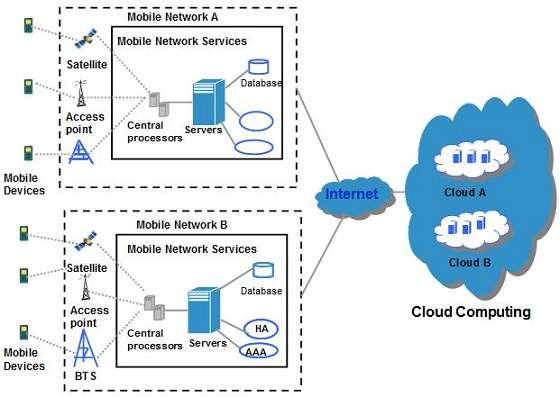
Cloud Computing offers such smartphones that have rich Internet media support, require less processing and consume less power. In terms of ...
-
Cloud Computing offers such smartphones that have rich Internet media support, require less processing and consume less power. In terms of ...
-
It refers to a type of Computer Programming in which Programmers define not only the data type of data structure, but also the type of Opera...
-
Cloud Security Challenges: Software as a Service Security: The seven security issues which one should discuss with a cloud-computin...
